Behind the scenes of OPA's architectural signage work at Xavier University of Louisiana.
From the interstate, the letters look almost effortless.
A towering vertical display spelling out XAVIER in illuminated gold, integrated into the architecture of the university's Living Learning Center.
It's bold. It's unmistakable. And it looks like it was always supposed to be there.
Which is exactly the point.
What you don't see from the road is the amount of creative thinking, planning, and fabrication experience it took to make that happen.
Because when you're putting giant illuminated letters on the side of a building, there's not much room for "close enough."
And that's where OPA comes in.

The Bigger the Sign, the More the Details Matter
At a certain scale, seemingly small design decisions become very big ones.
Letter spacing is a perfect example.
On a computer screen, it's easy to line up a series of letters and assume they'll look right.
But letters aren't all shaped the same.
Some are wide. Some are narrow. Some create more open space than others.
When they're arranged vertically on a multi-story building, those differences become much more noticeable.
And when the letters are halo-illuminated, the lighting can emphasize spacing and alignment even further.
For the Xavier project, our team worked through the individual letterforms, optical spacing, and their relationship to the building's architectural panels.
It wasn't enough for everything to be mathematically centered.
It had to look right to the person standing on the ground.
That's where experience makes a difference.
The Best Work Happened Before the Sign Went Up
One of the biggest advantages of working with OPA is that we understand what happens after the design is approved.
And sometimes, the smartest move is getting involved before the building is finished.
For Xavier University's Living Learning Center renovation, OPA collaborated with Gibbs Construction and VPG Construction while the architectural facade was still being developed.
That timing mattered.
Our team helped coordinate the letter layout with the building's panel seams and planned attachment points and electrical pass-throughs before the exterior cladding was completed.
Think about what that means.
Instead of finishing the facade and then figuring out how to attach a giant illuminated sign, the building and signage were planned together.
The result?
The final letter installation was completed in a single day.
Not because the project was simple.
Because so much of the difficult work had already been figured out.
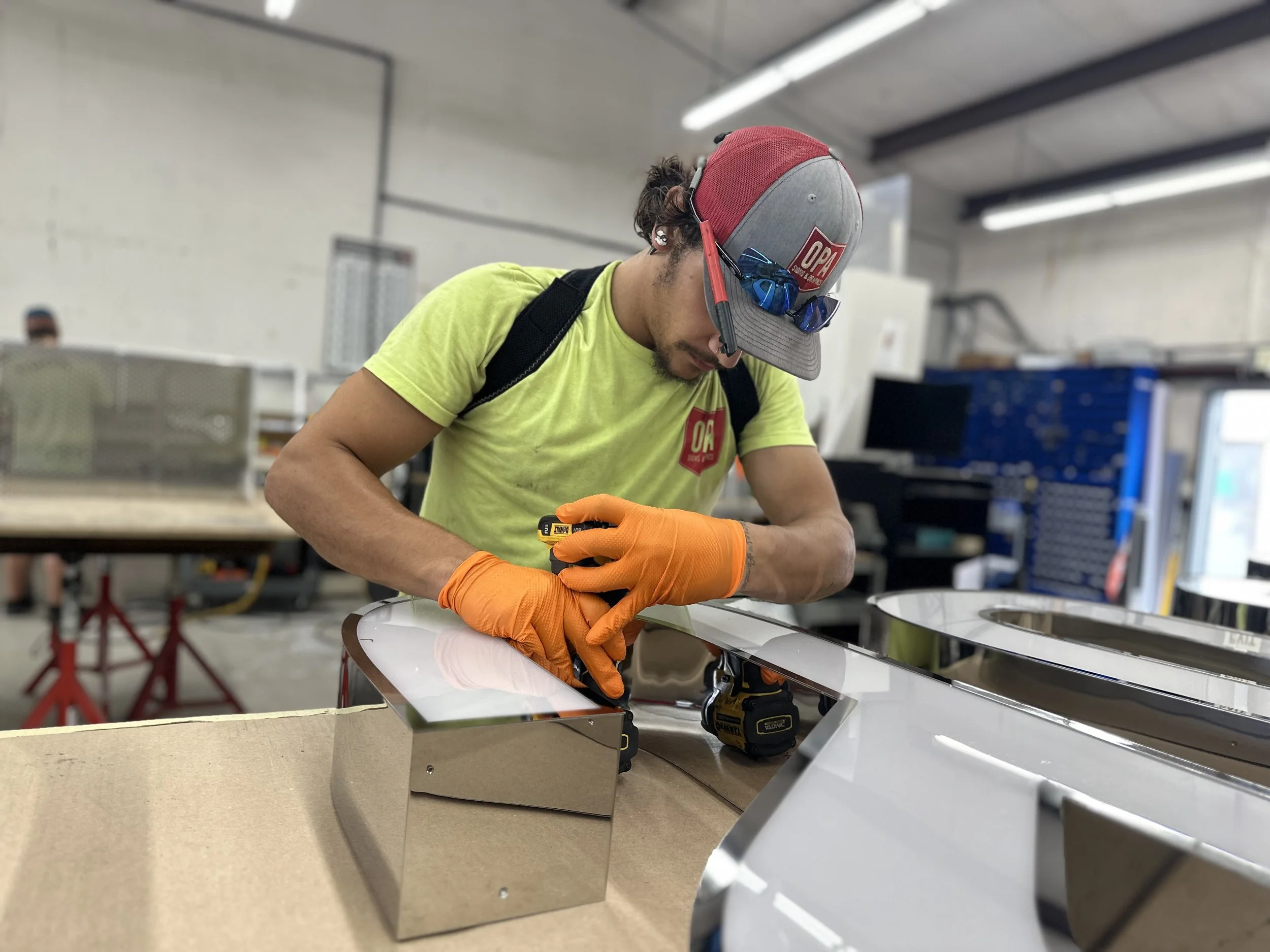
Architects Think About Design. Fabricators Think About Reality. We Think About Both.
We enjoy working alongside architects because the most interesting ideas don't always fit into conventional manufacturing methods.
A designer may envision a particular finish, an unusual dimensional feature, or lettering integrated into the structure.
The question becomes how to translate that vision into something that can actually be fabricated, transported, mounted, illuminated, and maintained.
That's a conversation we like being part of.
At OPA's 40,000-square-foot New Orleans facility, our team works across a wide range of materials and production methods.
CNC routing, laser cutting, custom metal fabrication, dimensional lettering, illumination, large-format printing, and installation all play a role in what we can accomplish.
Sometimes the solution is straightforward.
Other times, we have to rethink the construction method, develop a custom component, or find a smarter way to bring the pieces together.
The point isn't to complicate the design.
It's to protect the original idea while making sure it works in the real world.
One Building. More Than One Type of Sign.
The Xavier project also extended beyond the giant exterior letters.
OPA's work included interior wayfinding, ADA room identification, and large-format art installations.
Different functions. Different materials. Different scales.
But all contributing to the same environment.
That's an important part of architectural signage that sometimes gets overlooked.
The exterior sign creates an impression before someone enters the building.
Interior identification and graphics help carry that identity through the space.
And wayfinding helps people move through the building with confidence.
When those elements are considered together, the result feels more intentional.
Not like several unrelated projects happened to share the same address.
The Real Value of a Good Fabrication Partner
You don't need us to tell you that construction projects have a lot of moving parts.
Architectural details change. Timelines shift. Material questions come up. Different trades need access to the same spaces.
A good signage partner understands that reality.
We work to identify the important details early, coordinate with the people responsible for them, and make decisions that support the broader project.
Sometimes we receive a complete, approved sign package ready for fabrication.
Other times, we're part of the creative process from the beginning.
We're comfortable with both.
Because our role isn't simply to manufacture what's on the drawing.
It's to help make sure the finished project lives up to the vision behind it.
Have an Idea That Looks Great on Paper?
We'd love to see it.
Whether you're an architect working on a new building, a general contractor coordinating a complex installation, or a developer bringing a new property to life, OPA can help turn the vision into a finished result.
We've spent more than five decades doing exactly that.
And after all these years, the challenging projects are still some of our favorites.